Here’s a quick, slightly self-deprecating look at the Optimal Partner Profile: what it is, what I learned from it, and what happens after you take it.
I want to be honest about something. I have a low tolerance for online tests. You know the ones. Which Disney villain are you? What does your coffee order say about your inner child? Take this 47-question quiz to find out if your relationship will last. I scroll past them the way I scroll past LinkedIn posts that begin with “I was rejected from 47 jobs and here’s what I learned.” Polite skepticism. Limited engagement.
So when I agreed to take the Optimal Partner Profile, I approached it like most ten-minute commitments: half-paying attention, skeptical, and expecting not to be impressed.
I was not unimpressed.
What Actually Happened
The setup is simple. You answer about fortyish questions in six areas: your values, how you handle emotions, your attachment style, how you deal with conflict, your daily routines, and your long-term goals. The questions aren’t tricky or designed to trip you up. They don’t make you choose between two bad options to see if you’re secretly a sociopath. You just answer honestly, on your own, and it takes about ten minutes.
Then it spits out a result.
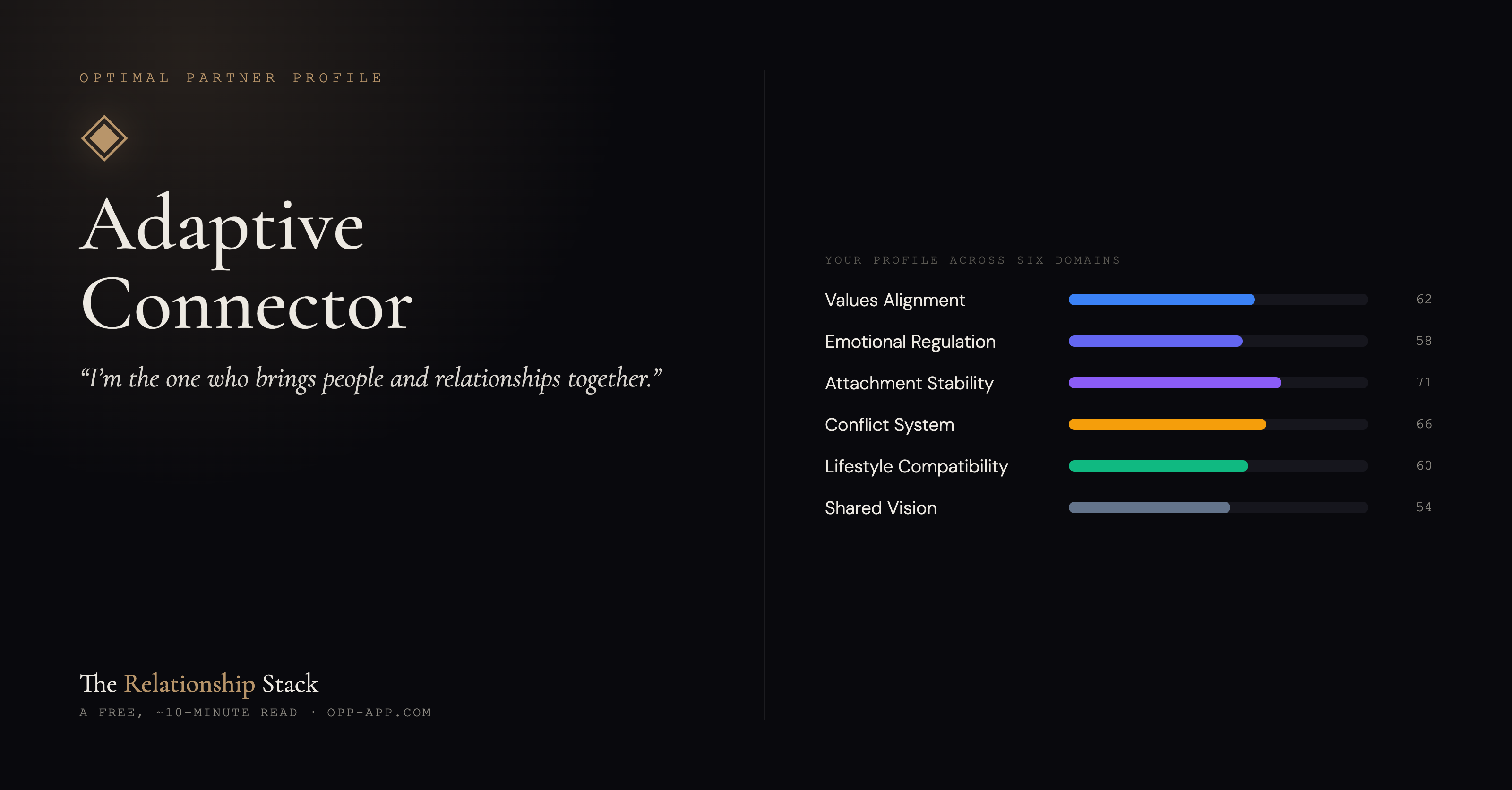
Mine labeled me as an Adaptive Connector: “I’m the one who brings people and relationships together.” It summarized how I show up in a relationship, where friction can arise, and what I should look for in a partner.
I read it twice. Then I read it a third time. Then I sat on my couch for a minute with the slightly unsettling feeling you get when a stranger correctly guesses what you had for breakfast.
It was, in fact, me.
The “That’s Me” Moment
There’s something odd about being described so accurately by software. At first, it doesn’t feel like validation. It’s more of a strange, uneasy feeling. We spend years shaping our self-image, highlighting our strengths and a few select flaws. Then, an algorithm made by strangers takes ten minutes of honest answers and quietly says: yeah, this is about right.
My Adaptive Connector domain scores, abbreviated:
- Values Alignment: 62 (apparently, I know what I value, but flex on the details)
- Emotional Regulation: 58 (okay, fair, sometimes I am a person who needs a minute)
- Attachment Stability: 71 (the highest score; surprised me a little but in a good way)
- Conflict System: 66 (I will engage with conflict, but I would rather not, thank you)
- Lifestyle Compatibility: 60 (workable, with caveats)
- Shared Vision: 54 (the one that made me go “hmm”)
I won’t bore you with details on every score. The main thing is that none of it felt vague or generic, like a fortune cookie or a horoscope. It felt specific, the kind of specific you can’t really argue with, even if you want to.
Wait, what is this actually doing?
Here is what I appreciated after the initial recognition wore off.
The tool isn’t trying to tell me who I should be with. It’s not a matching service. It’s not going to send me a curated list of compatible singles. It’s not pretending to know what it can’t know.
What it does is map how I act in relationships. It shows the patterns I bring, no matter who I’m with. It highlights the habits that show up when I’m tired, stressed, just starting out with someone, or years into a relationship. These are the parts of me that are steady enough to call structural.
This turns out to be more useful than I expected.
Most relationship advice I see treats relationships like separate events. You get tips like ‘five things to say to your partner tonight,’ ‘how to spot a red flag on the first three dates,’ or ‘why he hasn’t texted back.’ It’s all very situational and tactical, but it misses the bigger point: you bring the same version of yourself to every relationship. What’s happening in your relationships is often shaped by patterns you haven’t fully noticed yet.
The OPP simply shows you your patterns. That’s the whole idea. It’s a calm, structured look at how you operate in relationships.
I learned, for example, that my high score on Attachment Stability plays a bigger role in my relationships than I realized. My lower score on Shared Vision probably explains why some past relationships felt good at the time but struggled with planning for the future. I also saw that my Conflict System score is accurate; I will engage when needed, but I’d rather avoid it, and that avoidance has costs I haven’t always admitted.
None of this was exactly new information. But it was named and put in front of me in a way I couldn’t ignore. That’s the real value of a tool like this: not telling you something you didn’t know, but giving you words for what you already half-suspected.
And Then It Asked Me About Someone Specific
This is where it gets clever.
After you spend some time with your profile, the app offers you something it calls OPP Compatibility. The pitch is simple: now that you have your own profile, you can use it to see how you’d actually function with a particular person. Someone you’re dating. Someone you’ve been with for years. Someone you’re trying to figure out. It looks at how the two profiles line up on the things that matter most.
I’ll admit I was skeptical here too. Most “compatibility” tools I’ve encountered are either matching algorithms that require both people to take the test (awkward) or quizzes that pretend to know things based on five questions about your zodiac sign (insulting).
OPP Compatibility works in two steps. First, you describe what you’ve noticed about the other person: how they handle stress, how they show emotion, how they talk about the future, and anything else you’ve seen over time. Then, it asks you to describe how you act around this specific person, since you might show up differently with them than you do in general. Your OPP profile provides a structured view of those relationship patterns.
The other person doesn’t take anything. They don’t even know about it if you don’t want them to. It’s a tool for you, designed to work with the information you actually have.
What I noticed, when I tried it, is that it doesn’t pretend to know more than it does. When I hadn’t observed something clearly, I said so. When my read on someone was based on partial information, it told me what I’d need to notice to sharpen the picture. It felt less like being given an answer and more like being given a better way to think about the question I was already asking about compatibility.
The first read is free. A few weeks later, once the things I had marked as ‘too early to tell’ became clearer, I retook the Compatibility module. The dynamic became much clearer, and the results got sharper.
Why I’m Telling You This
I’m not generally the target audience for an app. I’m not someone who installs new things, takes new tests, or signs up for new newsletters. I default to deletion. Most things that show up in my inbox or my feed do not survive my first scroll.
What surprised me about the OPP, and the larger group of tools it’s part of (The Relationship Stack), is that it didn’t feel like just another thing fighting for my attention. It felt like a tool that respected the time I gave it. The questions were thoughtful, the results were honest, the follow-up wasn’t pushy, and the pricing was clear. The tone was more about what they could actually offer than about pretending to have all the answers.
If you’ve been in a few serious relationships and noticed the same patterns showing up, even when your partners seem very different, the OPP will probably help you name those patterns in a way that’s hard to forget.
If you’re in a long-term relationship that mostly works but has some friction you can’t quite explain, using both of these tools together will probably help you figure out what’s really going on.
If none of those situations fit you, you can still try the OPP. It’s free and only takes ten minutes. At worst, you’ll spend ten minutes thinking about yourself more honestly than usual, which isn’t a bad way to spend part of your week.
What I Did Next
I tried the Compatibility module with someone I’ve been seeing. The results were uncomfortably accurate in some areas and usefully vague in others. I’ll try it again in a few weeks, once I’ve noticed more.
I shared the OPP with two friends. One texted me, “This is upsetting in a good way.” The other called me, which usually means something really stood out. I found out I’m an Adaptive Connector, which feels both flattering and a little embarrassing at the same time.
I’ll probably keep using these tools since they gave me words for things I’d been feeling for a long time but couldn’t describe.
Try it yourself
- The Optimal Partner Profile: free, ten minutes, no signup required
- The Relationship Stack: writing on relationship architecture
- Relationship Architecture: Why Structure Matters More Than Communication (the foundational essay)